Handel 2009

Mary Granville Pendarves Delany, from an enamel, possibly by the painter, Barber.


Back to Handel 2009 BBC Radio 3
Handel House media partnership with BBC Radio 3
Handel House Museum and BBC Radio 3 are working in partnership to celebrate Handel's life and music in 2009, with special programmes to be broadcast on BBC Radio 3 throughout the year.
Handel Operas on BBC Radio 3
TAMERLANO (HWV 18)
Libretto: Nicola Francesca Haym
First performance: 31st October 1724, King's Theatre, London
Cast:
Tamerlano - Andrea Pacini (Alto castrato)
Bajazet - Francesco Borosini (Tenor)
Asteria - Francesca Cuzzoni (soprano)
Andronico - Francesco Bernardi, called "Senesino" (Alto castrato)
Irene - Anna Dotti (Contralto)
Leone - Giuseppe Maria Boschi (Bass)
Broadcast date: Thursday 23rd and Friday 24th April 2009
Catalogue no.: Avie AV 0001
Cast:
Tamerlano- Monica Bacelli (Contralto)
Bajazet: Tom Randle (Tenor)
Asteria - Elizabeth Norberg-Schulz (Soprano)
Andronico - Graham Pushee (Countertenor)
Irene - Anna Bonitatibus (Mezzo-soprano)
Leone - Antonio Abete (Bass)
The English Concert
Conductor: Trevor Pinnock
SYNOPSIS
Tamerlano, Emperor of the Tartars, has defeated and taken prisoner the Turkish sultan Bajazet. Although betrothed to Irene, princess of Trebizond, Tamerlano falls in love with Asteria, Bajazet's daughter, who secretly loves and is loved by Andronico, a Greek general and ally of Bajazet.
ACT I
The all-powerful emperor, ignorant of where Andronico's affections really lie, asks Andronico to plead his cause with Asteria, promising him in return the hand of Irene and the restoration of Byzantine power. He also promises to free Bajazet who, in despair at his defeat, desires only death. Irene arrives at the palace still believing she is to marry Tamerlano. Andronico breaks the news of her rejection by Tamerlano but persuades her to remain at court (disguised as a lady-in-waiting to protect her identity) in order to await developments. Betrayed by Andronico's apparent treachery, Asteria pretends to accept Tamerlano's love, which horrifies Bajazet and Andronico.
ACT II
Asteria accepts Tamerlano's proposal, her motive being to get near the tyrant, whom she will then try to assassinate. The outrage of Bajazet and Andronico at her apparent faithlessness causes her to change her mind at the last moment. The murder attempt having failed, the furious Tamerlano swears he will have Asteria and her father killed.
ACT III
Asteria's disdain, however, has changed him and he renews his offer to Andronico, only to have it rejected. Andronico now proclaims his love for Asteria. Once again Tamerlano swears revenge on all of them. During a banquet, Asteria (now a slave) tries to poison Tamerlano, whose life is saved by the intervention of Irene, who then reveals herself. Asteria is condemned to death and Bajazet is driven to suicide by the imminent execution of his daughter: only thus can he escape Tamerlano's power. In an impassioned monologue Bajazet calls on the Furies to take revenge on Tamerlano, then takes his own life. But his death so moves the emperor that he decides to pardon Asteria and give her hand in marriage to Andronico. Tamerlano himself will after all honour his betrothal to Irene.
Note: This particular recording can only be bought 'on demand' at www.arkivmusic.com.
***
A notable absentee from the cast was Anastasia Robinson, who had played major roles in all of the previous Royal Academy operas. Her disappearance from the stage was a puzzle to many, and only a few of her nearest friends knew that she had secretly married the Earl of Peterborough. In 1724 Peterborough publicly defended Robinson when she had been embarassed by Senesino's 'too near approach' during a public rehearsal. Peterborough challenged Senesino, made him apologise publicly on bended knee, and then caned him. Robinson was never to appear on stage again, and her marriage was not publicly acknowledged until many years later, just before Peterborough died.
On 12th December 1724, Mary Pendarves wrote a letter to her sister Anne enclosing sheet music of '...a song out of Tamerlane'. This was the first mention in her correspondence of a work by Handel, and over the next 35 years Mary would write to friends and family about her visits to Handel's operas and oratorios, providing a rich and personal record of the development and reception of Handel's music. In 1710 the 10 year old Mary Granville had met Handel briefly on his first visit to London, and was impressed by his virtuosity when he played her spinet. Later, in the 1730s as a widow living in London (her first husband Alexander Pendarves had died in 1718) she was a neighbour of Handel's, living just a few doors away in Brook Street. She became a close personal friend of the composer, and often had the privilege of being the first audience for his new works. Her sister Anne and brother Bernard were also devotees of Handel and his music, and Bernard was to be left a number of paintings in Handel's will.
Back to Handel 2009 BBC Radio 3
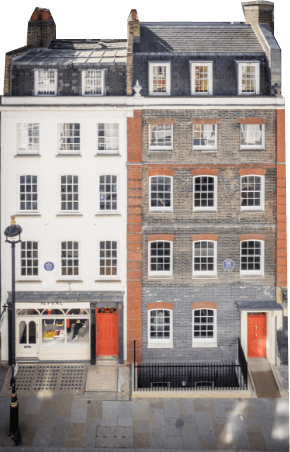
Handel House Museum at 25 Brook Street will be at the heart of the Handel celebrations next year. This landmark address is where Handel lived for thirty-six years of his life and where he died on 14 April 1759.