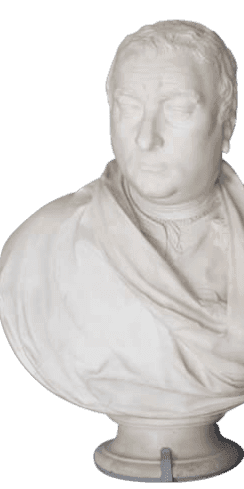
Handel had a number of different health complaints throughout his life including episodes of paralysis possibly caused by lead poisoning as a result of drinking alcohol from lead lined containers. Handel’s loss of sight came gradually to him in his later years, but eventually he lost his sight completely and was blind until his death in 1759. He did continue working and carrying out public engagements for a time but eventually felt the need to stay at home.
From the Companion Guide by Jacqueline Riding:
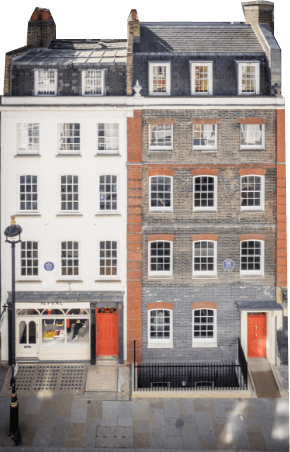
During the last decade of his life, Handel suffered from failing eyesight, culminating in full blindness by 1754. During the composition of Jeptha, Handel noted in German in the margin, ‘got as far as this on Wednesday 13 February 1751, unable to continue because the sight of my left eye is so weakened.’ Attempts were made to restore his sight – including recourse to the ‘quack’ oculist John Taylor (1702-72) who had operated on Johann Sebastian Bach (1685-1750) with failure in 1751 – but the operations were in Mainwaring’s words ‘as fruitless as they were painful.’ For his friends and biographers this situation was to cast Handel in a tragic light. Burney writes that Handel ‘was always much disturbed by the similar circumstances of Samson, whenever the affecting air in that Oratorio of “Total Eclipse, no Sun, no Moon,” &c. was performed.’ The 1759 inventory of Handel’s Brook Street house, lists a half-tester bed in the room adjoining Handel’s bedroom, which was probably used by a man-servant as Handel required greater assistance due to his blindness. The imposing full-length portrait commissioned by Charles Jennens and now in the National Portrait Gallery, dates from this period (1756).
RNIB
Since 2003, the Handel House Museum has been building a close relationship with the Royal National Institute for Blind People (RNIB). This has developed into an exciting programme of events throughout the year for blind and partially sighted people of all ages.
Visiting Handel House Museum
Admission prices and concerts
£5 for Blind or partially sighted visitors plus free entry for their carer.
We have many concerts at Handel House that are suitable for all including our Thursday Live series that takes place every Thursday at 6.30pm. For more information, please go to What’s on.
If you would like more information about events specifically designed for people who are blind or partially sighted at Handel House please contact us on +44 (0)20 7399 1953, email Claire Parker or the RNIB Music Advisory Service.
Historical rooms
For your own safety, you are advised to wear sensible shoes when visiting as the museum contains original 18th century floors which can be uneven. Stilettos damage the original flooring and leather soled-shoes are particularly unsuitable. Please note that certain rooms have low lighting.
Helpful volunteers
There are knowledgeable volunteers in the historic rooms who can talk to you about the rooms, the paintings and Handel’s life in Georgian London.
Information sheets
There are information sheets in every historical room which are available in English, French, German, Italian, Japanese, Portuguese, Russian and Spanish. There is also information in large print in all of the rooms.
Disabled Parking and Access
There is disabled parking on Brooks Mews and wheelchair access to the Museum from there. To get to Brooks Mews by car you will have to navigate the one-way system:
- Go down New Bond Street
- Turn right at Grosvenor Street
- Take the first right down Davies Street
- Take the first right onto Brooks Mews
- The parking bays are on the right hand side of the road
Wheelchair access to the Museum from Brooks Mews can be gained by going to the end of Brooks Mews. Turn left onto Avery Row (pedestrianised street). Turn right into Lancashire Court (small alleyway) and go down the ramp. Handel House Museum is straight ahead and the first building on the left.